

You Eat Well. So, Why Are You Still Constipated?
/
Most people assume constipation is a diet problem. Not enough fibre, not enough water, not enough vegetables. And if you're reading this, you've probably already tried all of that. You're doing everything right, and your digestion still feels off.
That's frustrating. It's also a sign that something else is going on.
The thing most people don't consider is stress. Not the obvious, acute kind. The low-grade, background kind that comes with a full life, a busy schedule, and a nervous system that never quite switches off.
Your gut follows your nervous system's lead
Your brain and your gut are in constant communication. When you're calm and rested, digestion runs smoothly. When you're stressed, your body shifts its priorities. It moves resources toward immediate survival and pulls back from things it considers non-essential. Digestion is one of those things.
For a lot of people, this shows up as things slowing down. Food moves through more slowly, bowel movements become less frequent, and that uncomfortable, stuck feeling sets in. It's not a malfunction. It's your body doing exactly what stress signals tell it to do. The problem is that your nervous system can't distinguish between a genuine emergency and a difficult week at work.¹
What happens when stress becomes the norm
An occasional stressful day doesn't derail your digestion. But when stress becomes chronic, cortisol stays elevated, and that's where things get complicated.
Research shows that persistently high cortisol slows the time it takes food to move through your system, makes your gut lining more permeable, and gradually shifts the balance of bacteria in your digestive tract.² Your gut wall also has receptors specifically designed to pick up cortisol signals, which means your digestion is quite literally wired to react to your stress levels.³
This is why a proper healthy diet sometimes isn't enough. The food choices are good. The nervous system is still running hot. And the gut keeps responding accordingly.
The feedback loop nobody talks about
Here's where it gets interesting: a stressed gut doesn't just result from stress, it creates more of it.
Between 90 and 95% of the body's serotonin is produced in the gut, not the brain.⁴ Serotonin helps regulate how food moves through your digestive system. When digestion slows and that process gets disrupted, the signals don't just stay local. They travel back up to the brain and affect mood, anxiety levels, and how your body handles stress going forward.⁵
Stress slows the gut. The gut signals back to the brain. The cycle continues. Adding more fibre doesn't touch any of that.
Practical things that actually help
The goal isn't to eliminate stress, which isn't realistic. It's to give your nervous system enough breathing room that your gut can do its job.
A few things worth trying:
Breathwork before meals. Even two or three slow exhales before eating shifts your body toward a calmer state. It takes about thirty seconds, and it genuinely makes a difference.
Putting your phone down while you eat. Eating while distracted keeps your nervous system in a low-level state of alert. Your gut registers that.
Gentle movement. Walking, stretching, and yoga support gut motility. Hard exercise when you're already depleted and stressed can sometimes make things worse, not better.
Prioritizing sleep. A lot of gut repair and regulation happens overnight. Chronic poor sleep is one of the most underrated contributors to constipation.
Magnesium. It draws water into the intestine, softening stool and supporting regularity. People with higher dietary magnesium intake have significantly lower rates of chronic constipation⁶ and a solid clinical track record.⁷ It's also something a lot of people are quietly deficient in.
These aren't replacements for good nutrition. They're the missing layer that explains why good nutrition alone sometimes isn't working.
One more thing
Constipation that doesn't resolve with diet changes usually has more than one driver. Stress is a big one. But hormones, gut bacteria, hydration, certain medications, and even posture on the toilet all play a role.
If you want to understand the full picture and work through it in practice, I've put everything I know in one place.
Constipation: A Holistic Guide to Finding Relief covers the root causes most guides skip, including the stress-gut connection, hormones, microbiome, and more. Five gut-friendly recipes, lifestyle tools, a laxative transition protocol, and a full FAQ. Everything I wish my clients had before they walked through my door.
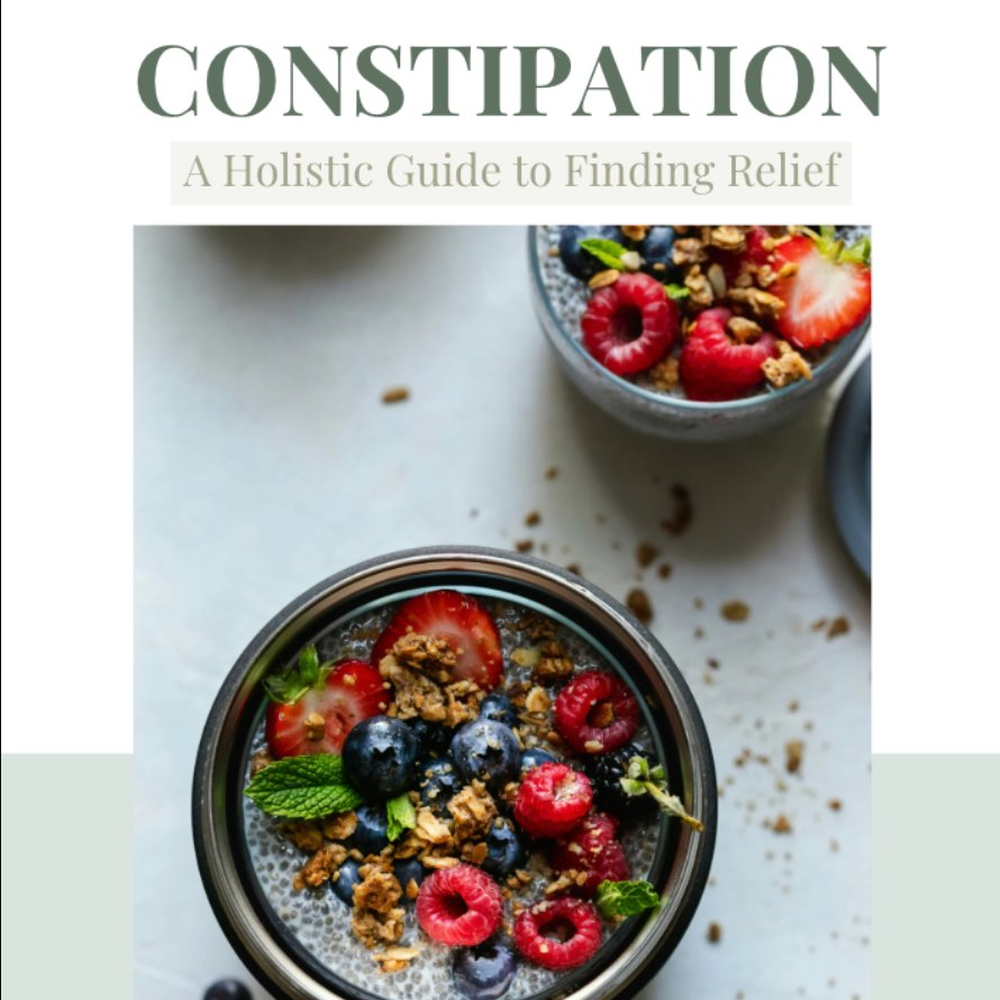
Constipation is one of the most common digestive complaints I hear in my practice and one of the most misunderstood. Most people assume it just means not going often enough. But it also shows up as bloating, discomfort, sluggishness, and that persistent sense that your body isn't quite working the way it should.
If you've tried more water and more fibre and still feel stuck, this is where to start.
What's inside:
Causes of constipation we often miss
The hormone-constipation connection: how estrogen, progesterone, cortisol, and thyroid all affect your digestion
Practical nutrition guidance on fibre, fats, hydration, and the foods that genuinely move things along
5 gut-friendly recipes with explanations of why each ingredient works
Lifestyle tools: breathwork, movement, sleep, and a squat posture tip that actually makes a difference
A travel protocol so your digestion doesn't fall apart the moment you leave home
A laxative transition plan for anyone who wants to reduce dependency safely
A full FAQ and glossary written in plain language — no medical degree required
Drawing on nearly 20 years of clinical experience as a Registered Holistic Nutritionist, I put together everything I wish my clients had before they walked through my door. Everything is grounded in research and written so you can actually use it.
This is a comprehensive roadmap you can return to again and again.
References
Leigh S-J, et al. The impact of acute and chronic stress on gastrointestinal physiology and function. J Physiol. 2023. https://doi.org/10.1113/JP281951
Rocha MX, et al. Exploring the complex relationship between psychosocial stress and the gut microbiome. J Appl Physiol. 2024. https://doi.org/10.1152/japplphysiol.00652.2024
Lum GR, et al. Signalling cognition: the gut microbiota and hypothalamic-pituitary-adrenal axis. Front Endocrinol.2023. https://doi.org/10.3389/fendo.2023.1130689
Mawe GM, Hoffman JM. Serotonin signalling in the gastrointestinal tract. Nat Rev Gastroenterol Hepatol. 2013. https://doi.org/10.1038/nrgastro.2013.105
Martin AM, et al. The influence of the gut microbiome on host metabolism. Front Physiol. 2019. https://doi.org/10.3389/fphys.2019.00428
Zhang L, et al. Association of dietary magnesium intake with chronic constipation among US adults. Food Sci Nutr.2021. https://doi.org/10.1002/fsn3.2611
Mori H, et al. Magnesium oxide in constipation. Nutrients. 2021. https://doi.org/10.3390/nu13020421